When the assumption changed
The existing direction was straightforward: move from selling data toward a more integrated SaaS platform and create a stronger one-stop-shop experience for market-access intelligence.
AI changed the assumptions underneath that strategy. Customers gained new ways to build, analyze, automate, and interact with data, raising a more fundamental question: if they no longer need a single interface to extract value, what role should the platform play?
Starting with how customers actually consume
I treated the problem less as a technology decision and more as a segmentation problem. Customers differ in budget, technical capacity, internal AI policy, and willingness to build.
Some want a turnkey product. Others want governed data access for proprietary analytics or internal applications. Some are investing heavily in AI-native workflows; others are moving cautiously. Those differences pointed toward multiple valid delivery models, not one destination for every customer.
AI did not eliminate the need for products. It made the preferred form of the product less predictable.
Repositioning the platform
The platform still had a clear role, but its value proposition needed to evolve. “One place for everything” was becoming less compelling in a market where intelligence increasingly moves into customers' own environments.
I reframed the platform around what it uniquely provides: a turnkey, governed, opinionated expression of MMIT's market-access intelligence—trusted data presented in a way customers can use without building and maintaining the analytical layer themselves.
Building the broader portfolio model
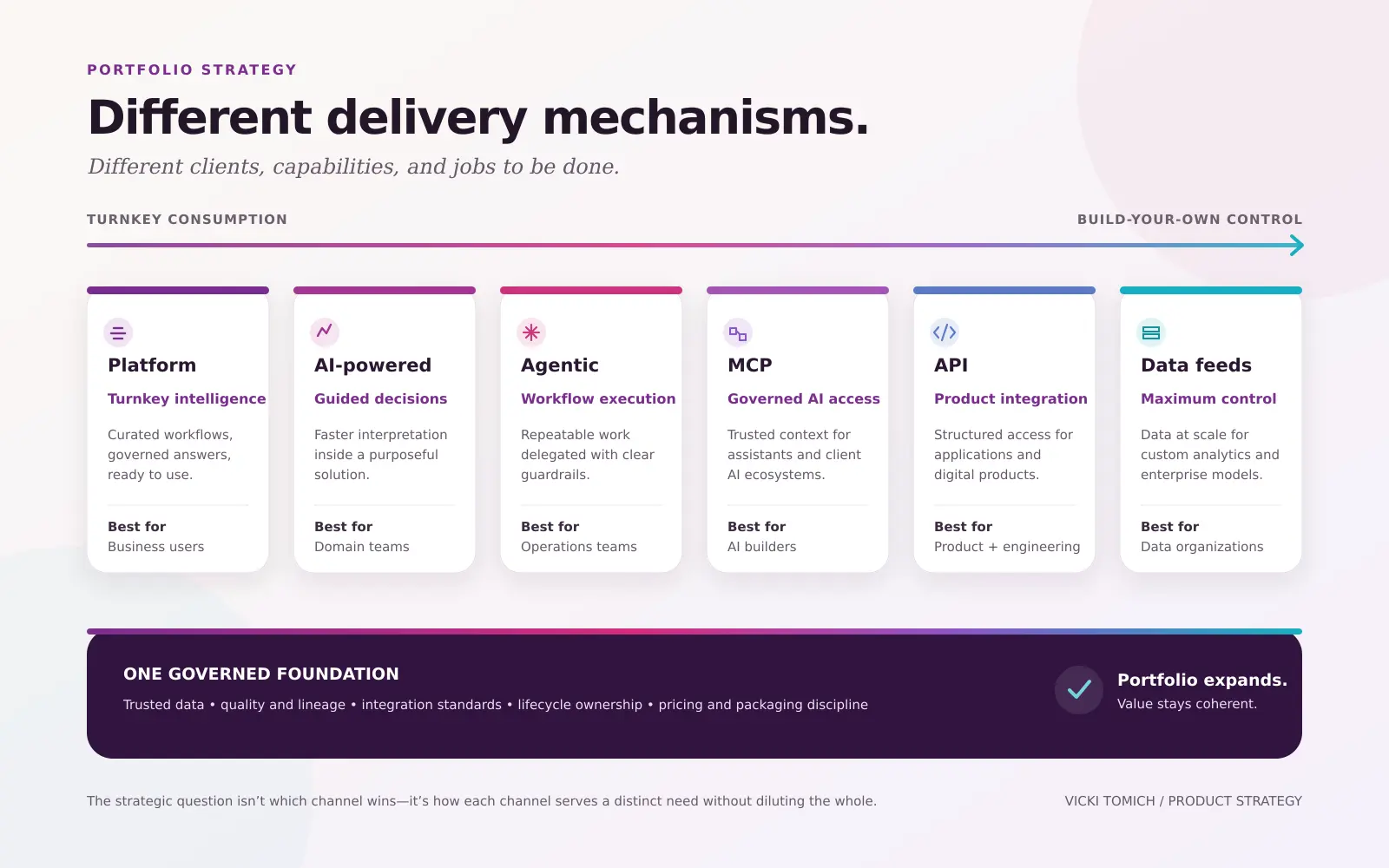
I mapped the major ways customers could consume the same underlying intelligence across core data, feeds, APIs, SaaS experiences, MCP, and increasingly agentic workflows.
I synthesized client conversations, conference feedback, competitive signals, internal perspectives, and broader technology adoption patterns to define the role, buyer, use case, and value proposition for each.
The goal was not to create a maturity ladder where customers eventually move toward the same endpoint. It was to become more deliberate about matching the delivery model to the buyer and use case—and more precise about how each offering should be positioned and commercialized.
Where the strategy is heading
The work is still evolving alongside the market, but the framework has gained momentum with stakeholders shaping the broader data and product strategy.
The core principle remains consistent: the strategic asset is the trusted data and intelligence underneath the portfolio. The interfaces around it should evolve with customer behavior rather than forcing every customer into a single way of consuming value.
Skills demonstrated: Portfolio strategy, market analysis, product positioning, buyer segmentation, pricing and packaging strategy, AI product strategy, platform strategy, and executive influence.